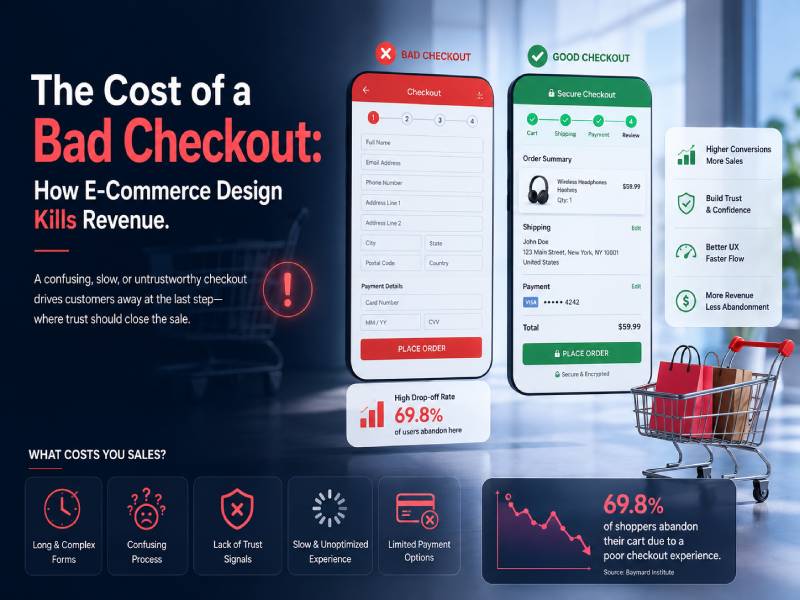
Introduction: The "Leaky Bucket" Phenomenon
The average cart abandonment rate hovers around 70%. Sit with that number for a second. For a business doing $10M in annual revenue, that represents nearly $7M in left-on-the-table potential — money that showed up, added items to a cart, and walked away at the finish line.
Think of your e-commerce store as a bucket. You spend thousands on SEO, PPC, and social media to pour traffic — water — into the top. But if the checkout, the bottom of the bucket, has holes in it, all of that investment simply drains away before it ever converts to revenue.
Fixing the checkout isn't a design nicety. It's the single highest-ROI activity available to any e-commerce business right now — higher than another dollar of ad spend, higher than another feature launch.
This article breaks down exactly why checkouts leak revenue, what it's actually costing you, and what enterprise-grade fixes look like when the goal is recovered revenue, not just a prettier interface.
Section 1: The Psychology of Friction — Why Users Abandon
Every extra click, every mandatory account creation, every hidden shipping cost demands mental energy from the buyer — this is cognitive load in action. The moment that friction exceeds the user's desire for the product, they bail. Not because they didn't want to buy. Because it stopped being worth the effort.
The Zeigarnik Effect: An Abandoned Cart Isn't Forgotten
Behavioral psychology gives us a name for what happens next: the Zeigarnik Effect — the tendency for people to remember incomplete tasks more vividly than completed ones. A bad checkout doesn't just lose the sale in the moment. It leaves the user with a lingering frustration attached to your brand, making them measurably less likely to return — quietly eroding Customer Lifetime Value (LTV) long after the session ends.
Finding the Exact Leak
You can't fix what you can't see. Enterprise-grade analytics tools — Hotjar, FullStory, or Google Analytics Enhanced E-Commerce — are essential for pinpointing exactly where users drop off in the funnel. Not "checkout is bad" in the abstract, but concretely: 40% abandon at the shipping-info page, 20% abandon at payment. That distinction is what separates a guess from a fix.
Section 2: The "Hidden Costs" of a Bad Checkout — The Financial Breakdown
Three specific checkout failures are responsible for the majority of preventable abandonment:
- Forced account creation — users want to check out as guests. Forcing a sign-up before purchase loses roughly 30% of potential sales, full stop.
- Unexpected costs — shock pricing at the final step (hidden shipping, taxes, handling fees) causes a 40%+ abandonment spike right at the moment of purchase intent.
- Slow load times — for every 100ms of delay in checkout load time, conversion drops by roughly 1%. Enterprise sites running bloated checkout JavaScript are hemorrhaging money one millisecond at a time.
A B2B chemical supply company with complex volume-tiered pricing had a legacy checkout that failed to display those discounts until the very final confirmation step. Buyers, confused by a final price that didn't match their expectations, abandoned carts en masse — not out of hesitation, but out of confusion. By redesigning the UI to show real-time price calculations via an enterprise pricing engine, the business reduced abandonment by 25% and increased Average Order Value (AOV) by 15%.
The Abandonment Math
Revenue = Traffic × Conversion Rate × Average Order Value (AOV)
Most e-commerce teams pour their entire budget into the Traffic variable — more SEO, more ads, more social spend. But if Conversion Rate is suppressed by checkout friction, every additional visitor you buy is diluted by the same leak. Improving conversion rate by even a few points multiplies against every dollar you've already spent acquiring that traffic — which is exactly why checkout fixes so consistently out-earn additional marketing spend.
Section 3: The "Enterprise-Grade" Fixes — Real-World Solutions
Practical Aspect A: Headless Checkout Architecture
Monolithic e-commerce platforms — legacy Magento, out-of-the-box Shopify — force a rigid, slow checkout flow that's difficult to customize and often slow to load. A headless approach decouples the checkout from the platform: a Headless CMS paired with a React or Vue.js frontend lets you build an ultra-fast, fully custom-designed checkout that loads in milliseconds instead of seconds, without being constrained by the platform's default templates.
Practical Aspect B: Multi-Provider Payment Orchestration
Enterprise-grade checkouts integrate multiple payment gateways — Stripe, Adyen, Braintree, PayPal, Klarna, and BNPL providers — behind a single, unified API, rather than hard-coding one processor and hoping it fits every customer.
A global fashion brand was losing international customers because their checkout only accepted Visa and Mastercard — while European shoppers preferred Klarna and Asian shoppers preferred Alipay. By implementing a payment orchestration layer, the brand began offering local payment preferences by region, instantly boosting international conversion rates by 30%.
Section 4: The "One-Click" Utopia — The Mobile-First Imperative
Over 70% of e-commerce traffic is now mobile. A desktop-optimized checkout squeezed onto a phone screen — tiny form fields, overlapping buttons, endless scrolling — isn't a minor inconvenience. It's simply unusable for a large share of your buyers.
Practical Aspect: PWA and Biometric Authentication
Progressive Web App (PWA) technologies, combined with biometric authentication (Face ID / Touch ID) on mobile devices, make genuine one-click purchasing possible — not a marketing slogan, an actual reduction in taps between "I want this" and "purchased."
Section 5: The Trust Deficit — Security Design Matters
If a checkout looks sketchy — missing SSL indicators, unfamiliar payment fields, an awkward redirect to a third-party page — users will not complete the purchase, regardless of how legitimate your business actually is. Trust in e-commerce is a design problem as much as a security problem.
Practical Aspect: Visible Trust, Invisible Friction
Embedding trust badges (Norton, McAfee, BBB) directly within the checkout UI, combined with dynamic CVV and 3D Secure verification handled inline rather than via a jarring redirect page, keeps the buyer's confidence high at exactly the moment they're most likely to hesitate.
An enterprise selling $20,000+ watches needed to build extreme trust into a checkout handling unusually high-value transactions. The fix: a "Verified by Visa" fallback flow paired with a live, machine-learning-based fraud-scoring system on the backend — approving legitimate high-value transactions instantly while flagging genuine fraud in real time. The result: high-value cart abandonment dropped by 40%, because buyers felt genuinely safe completing the purchase.
Quick Wins vs. Enterprise Overhauls
Not every fix requires a full architectural rebuild. Here's how to prioritize:
Quick Wins (Days, Not Months)
- Enable guest checkout — remove forced account creation entirely
- Surface shipping costs and taxes earlier in the funnel, not at the final step
- Add visible trust badges and security indicators near the payment form
- Compress and lazy-load checkout page assets to cut load time
- Instrument the funnel with session-replay or heatmap analytics to find your actual drop-off points
Enterprise Overhauls (Quarters, Not Days)
- Migrate to a headless checkout architecture decoupled from your core platform
- Implement a multi-provider payment orchestration layer for regional payment preferences
- Integrate a CDP for tokenized, one-tap returning-customer checkout
- Deploy real-time, ML-based fraud scoring to approve legitimate orders instantly
- Rebuild pricing display logic for complex B2B or tiered-discount scenarios
Conclusion: Stop Burning Ad Spend on a Broken Funnel
Every dollar spent driving traffic to a checkout that leaks 70% of it isn't marketing — it's money set on fire. The math is consistent across the industry: for every $1,000 spent on a checkout redesign, businesses typically see a $5,000–$10,000 return in recovered revenue within the first quarter alone.
Before you approve another marketing budget increase, ask your team a harder question: how much of the traffic we're already paying for is quietly disappearing at checkout?